Client Satisfaction Surveys: How Cleanliness Influences Ratings

The Power of a Spotless Space
First‑impression science shows that customers form judgments within seconds; visible cleanliness—spotless floors, restrooms, and dust‑free surfaces—signals professionalism, health, and attention to detail. Steritech’s data confirm that interior and exterior cleanliness scores correlate with CSAT at 0.9584 and 0.9764, and a 5‑point score boost lifts average monthly sales by 1.3%, adding roughly $26,300 in annual revenue for a typical limited‑service location. Because cleanliness drives both perception and profit, regular client‑satisfaction surveys are essential. Surveys that ask about overall cleanliness, restroom hygiene, and staff professionalism increase response rates by up to 40% and provide actionable insights, enabling cleaning firms to fine‑tune schedules, demonstrate ROI to property managers, and maintain the high standards that keep customers returning.
Why Cleanliness Matters – The Ten‑Point Checklist
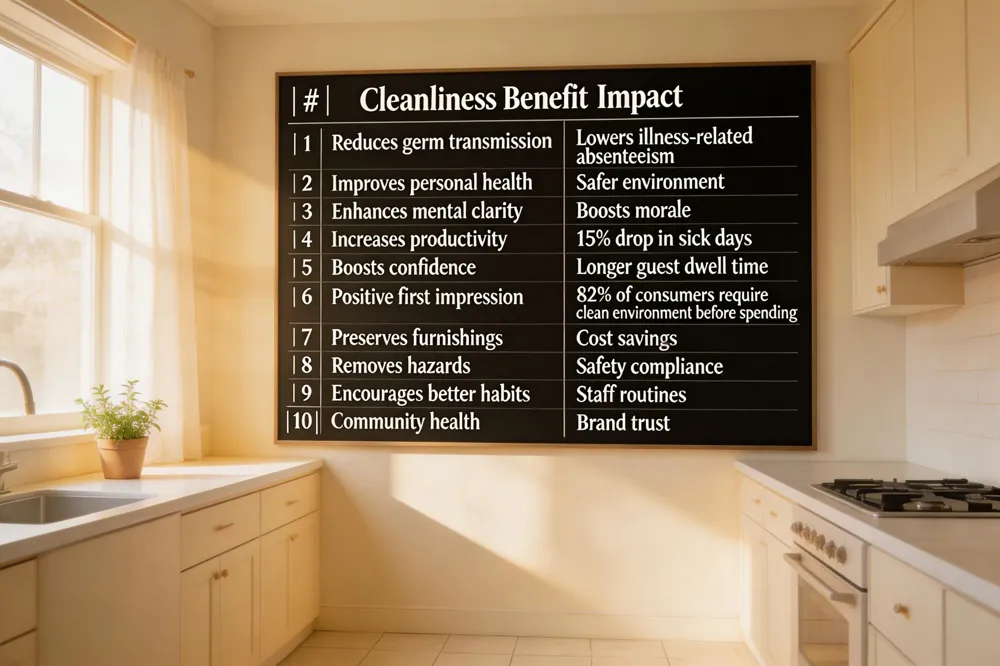
Cleanliness is a strategic business asset that directly influences health, mental well‑being, productivity, and brand perception. 1) Reduces germ transmission, lowering illness‑related absenteeism and supporting disease‑prevention goals highlighted by CDC estimates of a 40% reduction in respiratory illnesses with proper sanitation. 2) Improves personal health and well‑being, creating a safer environment for employees and customers. 3) Enhances mental clarity and reduces stress; studies show clean spaces boost morale and lessen anxiety, leading to higher employee satisfaction. 4) Increases productivity and morale – a 2023 Minnesota Business Health Survey reported a 15% drop in sick days when workplaces prioritize cleanliness. 5) Boosts confidence and self‑esteem, encouraging guests to linger longer and spend more. 6) Forms a positive first impression, with 82% of consumers saying a clean environment is essential before they spend money. 7) Preserves furnishings and equipment lifespan, delivering cost savings. 8) Removes hazards, supporting safety compliance. 9) Encourages better habits and routines among staff. 10) Contributes to overall community health and quality of life, reinforcing brand trust and loyalty.
The Five Points of Cleanliness and Core Cleaning Principles

What are the 5 points of cleanliness ?
- Time – Allow sufficient contact time for cleaning agents to break down soils while balancing efficiency and surface safety.
- Temperature – Apply appropriate heat to accelerate chemical reactions and reduce soil viscosity; higher temperatures improve cleaning but may affect cost or material integrity.
- Mechanical Action – Use the right amount of agitation, pressure, or motion (scrubbing, spray, ultrasonic) to lift debris without damaging surfaces.
- Chemical Reaction – Select and dose the proper cleaning chemicals, considering pH, alkalinity, hardness, and specific soil types for effective removal.
- Procedures – Follow standardized, well‑trained protocols to ensure each factor is applied consistently, preventing errors that could negate the benefits of the other four points.
What are the 5 basic cleaning principles? The same five elements—time, temperature, mechanical action, chemical reaction, and procedures—constitute the core cleaning principles. Time guarantees adequate product contact; temperature speeds up reactions; mechanical action provides the physical force needed to dislodge dirt; chemical reaction supplies the agents that break down soils; and procedures ensure repeatable, safe, and high‑quality results across all service environments. By integrating these principles, professional cleaning services deliver consistent cleanliness that drives higher customer satisfaction, increased sales, and stronger brand reputation.
Customer‑Centric Practices: The 3 C’s and Pricing Realities

Cleanliness is a measurable driver of revenue and loyalty. Steritech’s data shows interior cleanliness correlates with customer satisfaction at 0.9584 and drives a 1.3 % sales lift for a 5‑point score increase, while exterior cleanliness scores an even higher correlation (0.9764). To translate this into everyday service, Bravo Cleaning follows the 3 C’s of customer satisfaction: Commitment – delivering reliable, high‑quality cleaning that meets or exceeds expectations; Communication – providing clear, timely updates on schedules, special requests, and any changes; and Consistency – ensuring every visit—whether turnover, carpet care, or routine maintenance—feels uniform and dependable, reinforcing trust and loyalty. Regarding pricing, the U.S. market typically ranges from $35‑$75 per hour per cleaner. In Minneapolis, the average for insured, background‑checked staff using eco‑friendly products sits around $40‑$55 per hour. A $30‑per‑hour rate is below this range and may reflect a budget‑focused service with limited amenities. For most homeowners seeking reliable, high‑quality cleaning, paying $40‑$50 per hour usually guarantees the level of expertise, insurance, and sustainable supplies that underpin Bravo Cleaning’s reputation.
Efficiency Tricks: The 80/20 Rule and Hygiene Risks

What is the 80/20 rule in house cleaning? The 80/20 rule, or Pareto Principle, means that roughly 20 % of cleaning tasks deliver 80 % of visible cleanliness. By targeting high‑impact zones—floors, high‑traffic surfaces, bathrooms, and main‑area vacuuming—busy property managers can achieve a spotless look with minimal effort. This focus aligns with Steritech’s data showing that a 5‑point cleanliness boost adds $506 per week in sales for a typical limited‑service location, underscoring the revenue power of strategic cleaning.
How can poor hygiene impact your customers? Dirty restrooms and unclean high‑touch areas create a negative first impression, erode trust, and can drive patrons to competitors. Studies reveal that 94 % of consumers would avoid a business with cleanliness issues, while a single negative comment can outweigh dozens of positive reviews. Poor hygiene also raises illness risk, reducing employee productivity and increasing sick days. Eco‑friendly, consistent cleaning—backed by testimonials from Bravo Cleaning’s 20‑year Minneapolis clients—protects health, boosts loyalty, and safeguards brand reputation.
Driving Guest Loyalty and Measuring Cleanliness

Cleanliness is a cornerstone of guest loyalty. Studies show that 81% of hotel guests rate cleanliness as the most important factor when deciding whether to stay, and 94% would avoid a business with cleanliness issues. A spotless environment signals professionalism, health safety, and attention to detail, shaping the first impression within seconds. According to Steritech, interior cleanliness correlates with customer satisfaction at 0.9584, and a 5‑point score rise boosts average monthly sales by 1.3%. These drivers translate into higher repeat bookings, longer dwell times, and stronger word‑of‑mouth referrals.
The Cleanliness Satisfaction Scale (CSS) is a validated 19‑item instrument that quantifies perceived cleanliness across four dimensions: Fresh Waste, Dust Residues, Cleaning Quality, and Visual Impact. Developed with rigorous psychometric testing (Aiken’s V = 0.95, KMO = 0.931), the CSS provides actionable insights for property managers, allowing targeted interventions in high‑impact areas such as restrooms, entryways, and customer‑facing spaces. Incorporating eco‑friendly products and professional service guarantees consistent scores, reinforcing guest trust and driving revenue growth.
Data‑Backed Benefits: Cleanliness, CSAT, and Revenue

Steritech’s analysis of 135,000 U.S. locations shows Interior cleanliness correlates with CSAT at 0.9584 and Exterior cleanliness correlates with CSAT at 0.9764. A 5‑point cleanliness boost = 1.3% increase in average monthly sales, with an Overall cleanliness and sales correlation = 0.82333. For a typical limited‑service shop earning $44,231 weekly, that boost translates to 5‑point improvement can add $506 weekly (~$26,300 annually) for a $44,231 weekly sales location. Eco‑friendly detergents further enhance perceived cleanliness and align with growing sustainability expectations, boosting loyalty.
Outsourcing assessments lowers travel costs, standardizes evaluations, and increases frequency, delivering system‑wide insights that drive uniform standards. Professional crews follow the five basic cleaning principles, ensuring each task meets health and safety standards.
Key perception drivers: restrooms, entryways, customer‑facing spaces are the highest‑impact zones; spotless restrooms alone influence 86 % of diners’ perception of kitchen hygiene and drive 85 % of overall dining satisfaction. Investing in regular deep‑cleaning of these high‑traffic areas reduces absenteeism and reinforces brand trust.
What are the 5 factors of customer satisfaction? Product/service quality, customer service experience, convenience, speed of resolution, and clear communication.
What are the 5 basic cleaning principles? Time, temperature, mechanical action, chemical reaction, and documented procedures.
Turning Cleanliness Into a Competitive Edge
Effective survey design starts with short, focused questions—rating cleanliness on a 1‑5 scale, pinpointing high‑traffic zones, and allowing open‑ended comments. Embedding eco‑friendly cleaning metrics—biodegradable products, low‑VOC practices—turns sustainability into a brand differentiator that 63% of clients now expect. By collecting real‑time feedback and linking scores to Steritech’s proven sales‑cleanliness correlation (0.82333), managers can spot trends, adjust schedules, and demonstrate ROI. Continuous data‑driven improvement fuels higher CSAT, repeat business, and measurable revenue growth. These insights guide staff training, reinforcing professionalism and customer trust.
Recent articles